Four AI products, two principles: transparency and agency. 38.8% media list creation, 57.5% search adoption.

At Muck Rack I directed three designers and a writer across four AI-native products spanning different PR workflows. Every AI recommendation or action was accompanied by reasoning. Every result can be overridden. The consistency principle across all four: make AI reasoning visible (transparency) and keep the human in control (agency).
In 2025, my team at Muck Rack designed four AI-native products across the PR workflow: tools for monitoring coverage, building media lists, optimizing pitch targets, and responding to inbound inquiries from journalists. Each one required a slightly different answer to the same questions: how much should the AI do, and how much should the user stay in control? Based on our user research, we knew the answer was influenced by multiple factors, primarily: the stakes of the task, the user's expertise, and how much they trust the system.
I directed three designers and a writer across these projects. My role was ensuring a consistent experience: all four products needed to feel like they came from the same system, operated on the same principles, and respected our PR team users.
AI Search Agent
PR teams monitor coverage using Boolean search queries that most PR professionals frequently don't understand how to effectively construct. The Search Agent solved this by translating natural language monitoring goals into valid Boolean queries. You say what you're looking for and the agent builds a search using valid search syntax.
The design problem was making this expert-level output accessible to users with no search expertise, while preserving the power and precision of Boolean logic. This required deep behavioral specifications and guardrails covering: intent inference (understanding what the user is actually trying to find), entity handling (recognizing brands, topics, keywords), query construction standards (building syntactically correct searches), transparency requirements (showing the user what query was built and why), and failure modes (how the agent recovers when it doesn't understand the request, or when the query returns no results). The rigor of that underlying specification is what makes PR teams’ experience in Muck Rack feel trustworthy.
57.48% of prompts led to viewing coverage on search results screen. 44% returning user rate.
AI Media List Builder
You describe the journalists you want to reach in plain language (e.g., "Tech journalists who cover startups and AI" or "Automotive journalists with international audience reach") and the agent assembles a targeted list in seconds.
The design problem was making AI-generated recommendations feel trustworthy enough for the PR team to then use that media list in real outreach, where their professional reputation is at stake. We built our solution so that every recommendation came with a detailed match explanation: a summary of why we matched them, their top topics (e.g., automotive, motorsport), their audience scope (consumer, international, trade), and their top entity mentions in recent coverage (e.g., Porsche, Ferrari). Every result can then be refined by topic, outlet, and location. And the conversational thread model allows PR teams to iterate and refine rather than starting over from scratch.
38.78% of sessions led to media list creation. 44% of users returned within 30 days.
AI Optimized Pitch Recipients
When a PR team sends a pitch, they need to know which journalists are most likely to care enough to open the pitch and then respond. The Optimized Pitch Recipients Agent evaluates every journalist in the Muck Rack database against a pitch and surfaces the most relevant recipients with reasoning.
The design challenge was building enough transparency that PR teams would trust the recommendations without feeling replaced by the AI. We showed the reasoning for each match which PR teams could accept or reject recommendations.
This release also included a set of small but significant overdue UX improvements to the pitching flow itself: restructuring the flow to be faster by reducing the overall number of steps by 20%.
Customer reaction at launch: "The pitch recipient optimization tool is KILLER." Among recommended recipients, click-to-open rates doubled compared to non-recommended ones. Email open rates improved by 10%.
Media Brief Agent
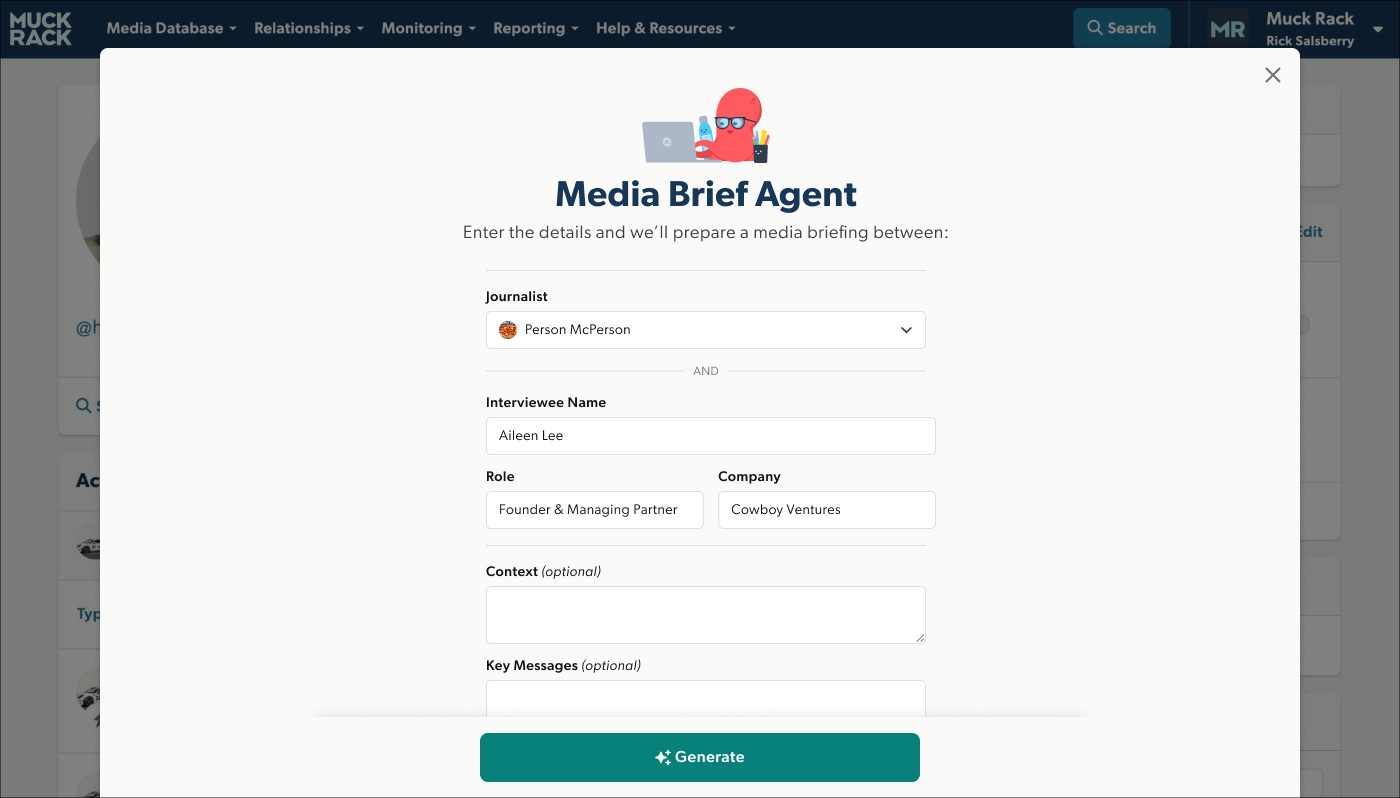
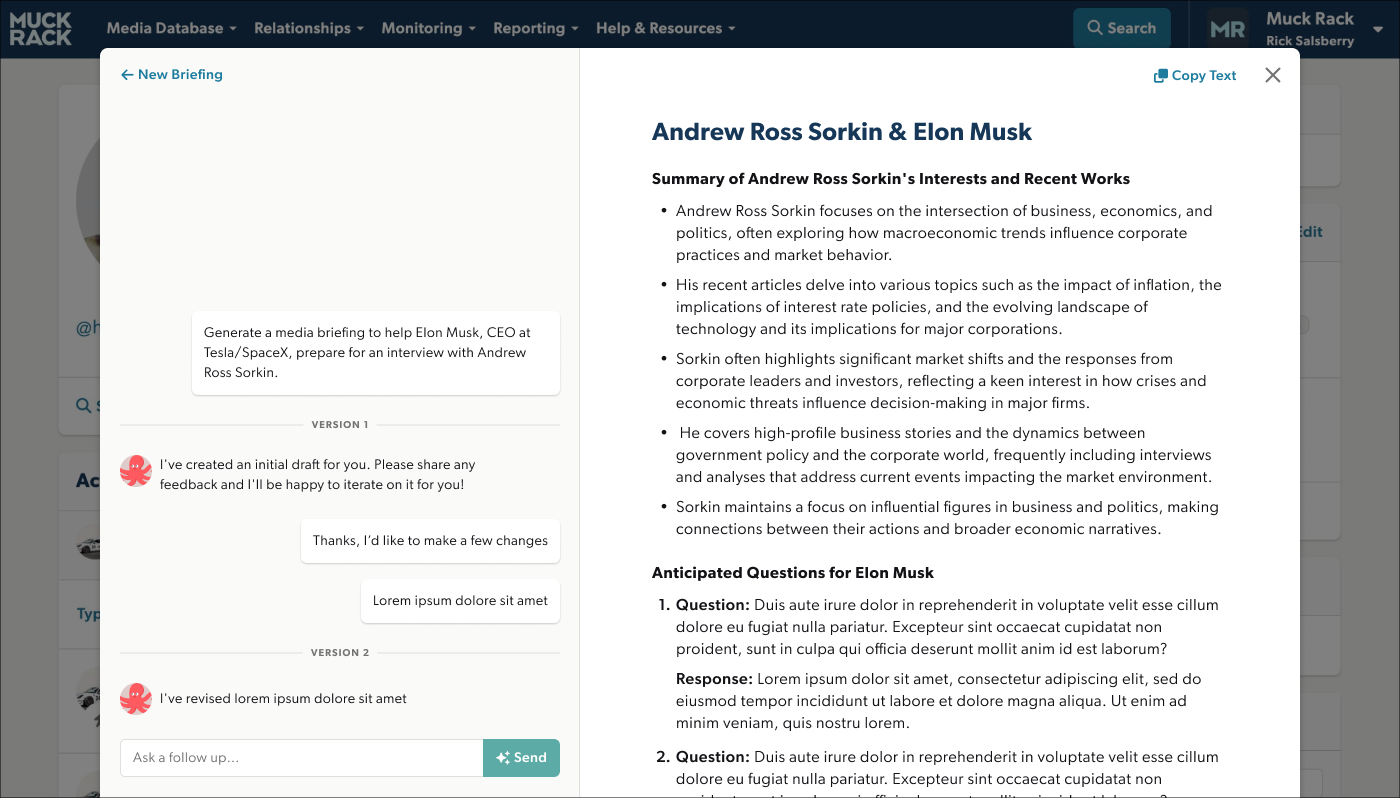
When responding to inbound inquiries from journalists (e.g., requests for comment, crisis comms), PR teams need context fast. The Media Brief Agent generates a complete journalist briefing document in seconds: background on the journalist, their coverage themes, potential questions they might ask, and suggested response angles. All without leaving the workflow.
Consistency Across Four Products
My role across all these products was ensuring they operated on a consistent set of principles and felt like part of the same experience. The through-line: two principles, applied consistently across all four. Transparency: make AI reasoning visible. Agency: keep the human in control. We brought this to life by requiring that every AI-generated output is accompanied by reasoning and every recommendation can be overridden.
Those principles sound simple, but the challenge was executing it consistently across four different products, four different user contexts, and four different risk profiles: media discovery, list building, pitch optimization, and crisis response. The consistency primarily about trust and not just aesthetics or interaction patterns. If PR teams trusted the AI to be transparent in one context, they're more likely to trust it in another. And, if they understand how one agent reasons, they're faster to understand the next one.
To make that consistency operational, I worked with my team to build two foundational artifacts.
The first was a platform-wide AI governance framework: 11 behavioral guardrails we applied across every agent on the platform. The guardrails cover scope enforcement, tool transparency, intent-led interaction, capability disclosure, state preservation, error recovery, latency expectations, voice and tone, and bias mitigation. Every agent ships compliant with all 11.
The second was the Agent Specification Template: a mandatory pre-development source of truth used by product, design, engineering, and QA before any agent moves into build. It covers agent purpose, scope, adjacent agents, input and output types, agent-specific guardrails, edge cases, adversarial and misuse scenarios, failure handling, UX patterns, and pre-launch checklists. The template exists because we found agentic products failed in specific, predictable ways: mishandled edge cases, unclear failure states, inconsistent transparency, etc. This template helped us align every stakeholder before the first line of code and prevent these failures.
AI product design is a dance between how much control we take away from humans and give to an AI and how we earn the trust of our users so they let go of tasks an AI does faster, better, and more efficiently than humans. We solved that across four products using two principles defined based on research with PR teams: transparency and agency.